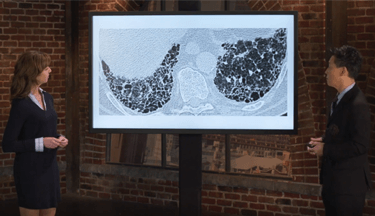
Respiratory Bronchiolitis-Associated Interstitial Lung Disease
DIAGNOSIS
SYMPTOMS
- Patients with RB-ILD are typically asymptomatic with some patients experiencing a subclinical decline in lung function3
- In cases where patients are symptomatic, they typically present with mild dyspnea and cough7
- Bibasilar end-inspiratory crackles are one of the most common signs of RB-ILD although they are not observed in all patients5
DIAGNOSTIC TESTS
Pulmonary function tests
- In patients with moderate symptoms there may be a mild to moderate reduction in DLCO2
- For patients with more severe disease, features of both airway obstruction and restriction may be observed due to concomitant emphysema2
HRCT
- Features: Ground-glass opacities and centrilobular nodules with bronchial wall thickening1,6
- Distribution: Diffuse or upper lung predominance6
Bronchoalveolar lavage
- Smoker's macrophages and absence of lymphocytosis1
Surgical lung biopsy is not needed if HRCT and bronchoalveolar lavage (BAL) criteria are met.1
- Pattern of bronchiocentric accumulation of macrophages containing brown particles with mild bronchiolar fibrosis6
There is histologic overlap between respiratory bronchiolitis (RB), desquamative interstitial pneumonia (DIP), bronchiolitis and NSIP with RB and DIP representing either end of the spectrum.2
The most common findings on chest HRCT are thickening of the walls of central or peripheral bronchi and ground-glass opacity.2