Reviewing tests and scans
Earlier identification of pulmonary fibrosis on imaging is critical1,2

HRCT is the standard in diagnosing ILD1
HRCT is more sensitive in detecting ILD than chest radiography or conventional chest computed tomography, and improves detection of all abnormalities1,3
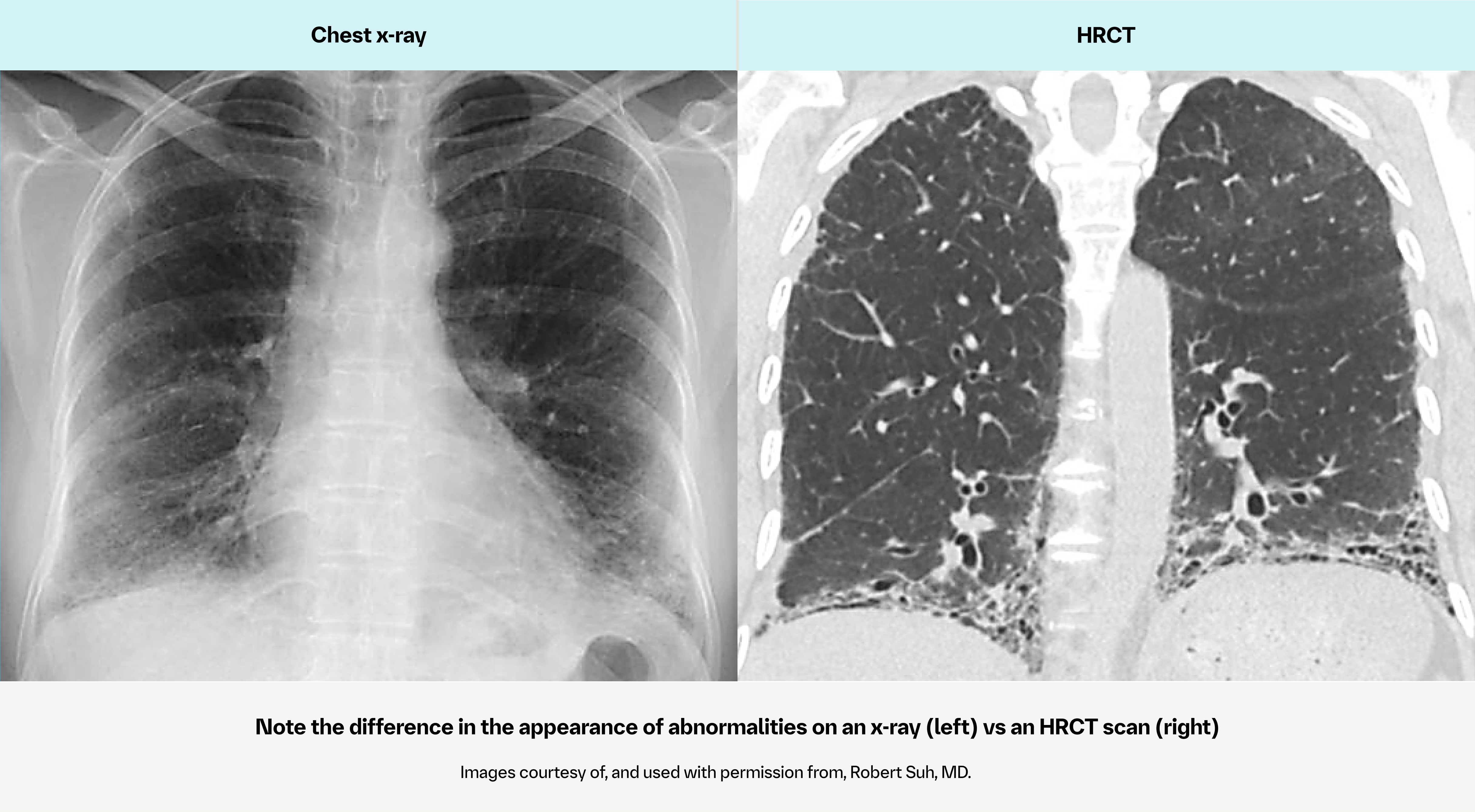
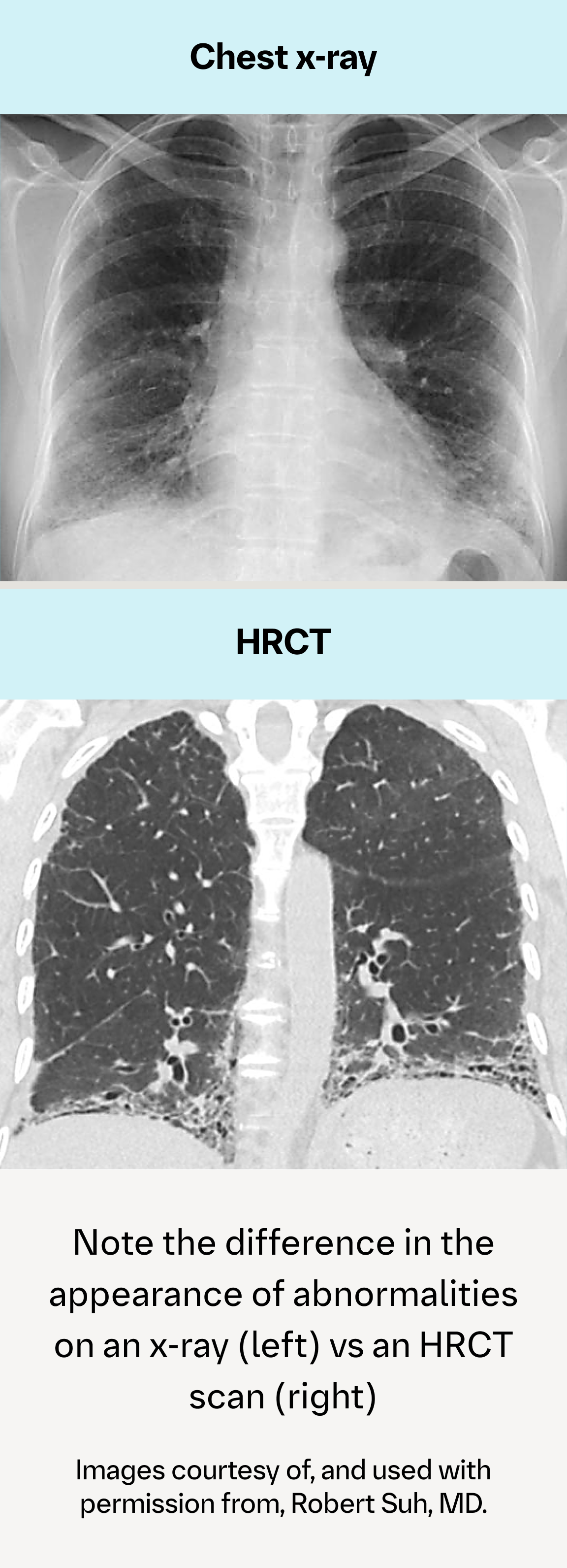
Normal chest x-rays do not rule out ILD2
An abnormal chest x-ray is often the first indication of ILD—even prior to the development of symptoms or physiologic impairment. However, HRCT allows for the recognition of abnormalities that may not be apparent on chest x-ray.1
Features of lung fibrosis seen on HRCT include4:
- Reticulation
- Traction bronchiectasis
- Honeycombing
While chest x-ray is not sensitive for ILD diagnosis, it can play a role in identification1
Findings on chest x-rays suggestive of ILD may include features of interstitial changes and/or airspace disease, such as5-7:
- Reticular lines or scarring
- Volume loss, hilar retraction, or architectural distortion
- Honeycombing
- Nodules
- Ground-glass opacification or air bronchograms
- Cysts or cystic change
Take prompt action if ILD is suspected and refer to a lung specialist for further evaluation2



CT, computed tomography; HRCT, high-resolution computed tomography; ILD, interstitial lung disease; PCP, primary care physician; PFT, pulmonary function test.
References
- Walsh SLF et al. Eur Respir Rev. 2018;27(150):180073.
- Zibrak JD, Price D. NPJ Prim Care Respir Med. 2014;24:14054.
- Raghu G et al. Am J Respir Crit Care Med. 2018;198(5):e44-e68.
- Ryu JH et al. Mayo Clin Proc. 2007;82(8):976-986.
- Lynch DA. Imaging of diffuse parenchymal lung diseases. In: Schwarz MI, King TE Jr, eds. Interstitial Lung Disease. 5th ed. People’s Medical Publishing House; 2011: 109-110.
- Chae KJ et al. Korean J Radiol. 2021;22(3):454-463.
- Palmucci S et al. Insights Imaging. 2014;5(3):347-364.
- Wijsenbeek M, Cottin V. N Engl J Med. 2020;383:958-968.